When Innovation Meets Trauma: Reflections from Leumit’s Research and Innovation Conference
- Gila Tolub

- 4 days ago
- 6 min read
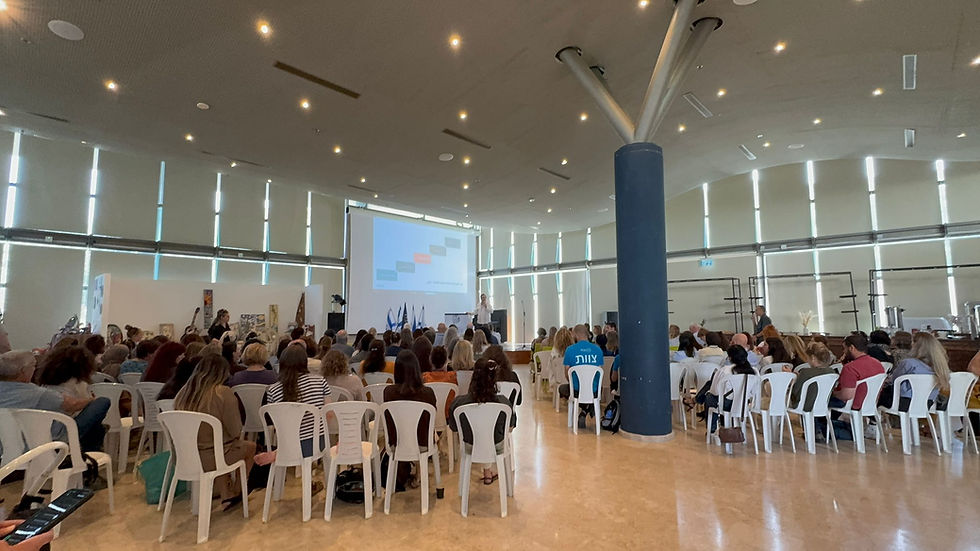
Last Wednesday, I attended Leumit’s Research and Innovation Conference. On the surface, it was a conference about digital health, diagnostics, AI, data, and partnerships between a health plan, academia, and startups.
But for me, the most important question running through the day was broader: what would it take for our health system to understand trauma not only as an individual psychological experience, but as a population-level health challenge?
The answer was present throughout the conference.

It was in the way Leumit described its research institute not only as a place that gives access to data, but as a partner in shaping products and studies that can work in real clinical settings. It was in the examples of AI being used to turn messy, fragmented clinical information into usable research data. It was in the presentation on home diagnostics and the promise of bringing care closer to patients. And it was most clearly present in the discussions on stress, trauma, mental health, and long-term health.
Prof. Alon Chen opened one of the most important conceptual windows of the day. He reminded us that mental health is still far behind other areas of medicine. Even compared with oncology, psychiatry has been left behind. Not because the field is not important, but because the science is so complex.
Psychiatric conditions are not caused by one gene, one mutation, one event, or one pathway. They emerge from the interaction between genetic predisposition, environment, stress, lifestyle, and time.
He called this the “Gene-Environment-Time Interaction.”
That phrase stayed with me.
Because in Israel today, we are living inside that interaction. We are not only treating the effects of one traumatic event. We are trying to understand what happens when exposure to stress and trauma becomes repeated, prolonged, and unevenly distributed across families, communities, and regions.
Prof. Chen was direct about the limitations of our current categories. “Today, we are oversimplifying the definition of disease,” he said. That oversimplification has real consequences. When we do not define conditions precisely enough, we cannot treat people precisely enough.
He gave the example of depression. A patient may begin a medication and wait four to eight weeks to see if it works. Often, it does not. Then another medication is tried, often with a similar mechanism. This can happen again and again. “At the end of the year,” he said, “30 to 35 percent of patients still do not respond.”
His conclusion was simple and important: “We cannot treat everyone the same way.”
This is at the heart of the challenge we face in trauma healing today. Not every person exposed to trauma needs the same intervention. Not every community carries the same risk. Not every child, parent, soldier, survivor, or caregiver will respond in the same way. And not everyone who suffers will show it through the same diagnosis.
That is why data matters. Not data for its own sake, and not dashboards that sit on a shelf. We need data that helps us see patterns earlier, understand risk better, and match people with the right kind of care at the right time.

This theme came up again in the presentation by Prof. Maya Levanon from the Weizmann Institute, who presented research on the long-term health impact of repeated security-related stress in southern Israel. She described how the body responds to stress by activating physiological systems designed to help us cope. But when stress is repeated or prolonged, the body may no longer return fully to balance.
“If the stress repeats, or if it continues over time,” she explained, “the body cannot return to that balance.”
Her research used health data to examine years of exposure in southern Israel, comparing populations exposed to different levels of threat. What was especially important was that the research did not treat stress as one uniform category. It looked at intensity, proximity, duration, age, and sex.
That level of nuance matters.
The findings showed that different groups were vulnerable in different ways. Women aged 46 to 64 showed high rates of stress-related psychiatric morbidity in some exposure areas. Men in high-exposure areas showed troubling mortality patterns. Children showed dose-dependent patterns in immune-related outcomes and ADHD diagnoses. Among adolescents in higher-exposure areas, the rates of ADHD diagnosis were striking.
The point is not to reduce all of this to one simple conclusion. The point is the opposite. Trauma does not affect everyone in the same way. It does not remain only in the mind. It can show up in the immune system, in metabolism, in liver markers, in mortality, in children’s development, and in patterns that only become visible when we look across populations over time.
This is why population-level trauma surveillance is so important.
In another moment that felt especially relevant, Prof. Chen spoke about resilience. He said that biomedical research has traditionally focused on why people become ill. “We asked why X develops a disease,” he said. “Why does he have PTSD? Why does he have this or that illness? We asked much less why he does not develop disease.”
This is a critical shift. In trauma work, we often focus on pathology because the suffering is urgent and visible. But if a group of people is exposed to the same traumatic event and only some develop PTSD, the question is not only what went wrong for those who became ill. The question is also what protected those who did not.
Prof. Chen reminded us that the brain has systems that create vulnerability, but it also has systems whose role is coping. If we understand those systems better, we may be able to develop new ways to support resilience.
Because while we wait for better biomarkers, better treatments, and more precise psychiatry, people still need help now. Prof. Chen emphasized that cognitive and behavioral therapies matter and can be as effective as available treatments when delivered well. But he also acknowledged the access challenge: waiting lists are long, and the system cannot rely only on traditional one-on-one care.
He then turned to the simpler things, which are sometimes dismissed because they sound too basic: movement, social connection, enrichment, meaningful activity.
“You do not need to be an iron woman or man,” he said. “Take the stairs.”
He spoke about physical activity and the brain. He spoke about social interaction. “Human beings are super social creatures,” he said, reminding us how clearly we saw this during COVID. And then he added a practical message: do what helps bring your stress down. For him, it might be kayaking in the sea or working in the garden. For someone else, it might be reading a book, walking, praying, volunteering, or sitting with family.
This matters because trauma healing cannot be reduced to clinics. Clinics are essential, but they are not enough. Healing also happens in families, communities, schools, workplaces, army units, peer groups, and everyday routines that help people regain a sense of safety, agency, and connection.
One of the most encouraging parts of the conference was seeing how Leumit is trying to build the infrastructure for practical innovation. The examples were not abstract. They were grounded in implementation.
One speaker described the challenge of pulmonary function data arriving from many different providers in many different formats: tables, free text, inconsistent structures, inconsistent labels. Instead of accepting that fragmentation as inevitable, the team used AI to extract and standardize the information into a structured table that could support research.
That may sound technical, but it is exactly the kind of work healthcare systems need. Before we can learn from data, we often need to rescue it from the chaos of real life.
The same was true in the presentation from Acurine, which is developing urine-based home diagnostics. The company described a future in which some clinical questions can be answered earlier, less invasively, and closer to home. Blood tests will remain important, but they are not always available at the right moment. A home-based test could help patients, families, and clinicians make faster decisions, especially for children, older adults, and patients who are hard to bring into clinics.
The connection to mental health may seem indirect, but it is important. The future of care will need to be more distributed, accessible, and responsive. This is true for diagnostics. It is also true for trauma and mental health.
If we want to respond to Israel’s trauma crisis, we need the same innovative mindset: not just more services, but better identification, better triage, better navigation, better measurement, and better integration into everyday care.
The Leumit conference was a reminder that innovation is not only about technology. It is about building the capacity to see reality more clearly and respond more intelligently.
For Israel, at this moment, that is not a luxury. It is part of how we heal.


Comments