Harm Reduction in a Changed World: Meeting People Where They Are
- Gila Tolub

- 14 hours ago
- 6 min read
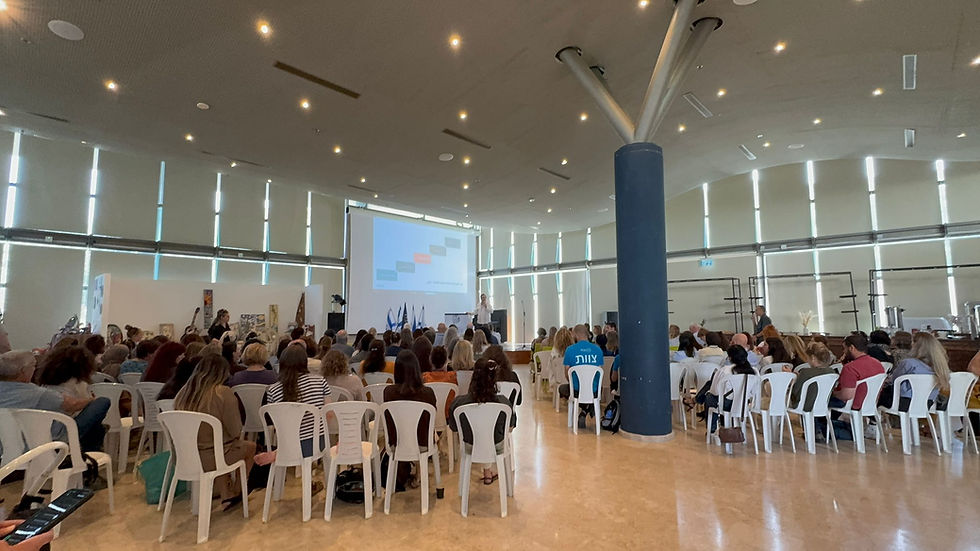
On June 1, I attended the Israel Center for Addiction and Mental Health conference on harm reduction in addictions. ICAMH, formerly ICA, convened clinicians, policymakers, researchers, and field professionals for a conversation that felt especially urgent in Israel today. The title itself captured something many of us have been feeling since October 7: “A Changed World.”

This was not only a professional conference about substance use. It was a conversation about what happens to people, families, communities, and systems when pain accumulates, when stress becomes chronic, and when the usual categories of “discipline,” “treatment,” “choice,” and “risk” no longer fully explain what we are seeing.
The morning opened with Prof. Shauli Lev-Ran, Founder and Academic Director of ICAMH, who framed harm reduction not as a compromise, but as a serious clinical and public health responsibility. He spoke about the gap between the world we wish people lived in and the world they are actually navigating. In that gap, he argued, our role is not to moralize. It is to reduce danger, preserve life, and help people find a way back.
One line from his talk stayed with me:
“The only way to recognize and treat something is to acknowledge it.”
It sounds simple, but in the trauma field it is often the hardest step. When trauma centers, mental health systems, schools, army frameworks, or families avoid talking about substance use, they are not making the problem disappear. They are missing an opportunity to intervene.
Shauli named three common responses to substance use: we blame and punish; we ignore and deny; or we acknowledge the reality and try to reduce harm. His concern was not only about the places that still blame. He was particularly worried about the “good” places, including trauma treatment centers, that simply do not address substance use. “In every trauma treatment setting,” he said in effect, “there is a lot of substance use. And what do many centers do with it? Nothing.” That “nothing” is not neutral. It leaves people alone with shame, risk, and escalating behaviors.
This is where the conversation became deeply connected to trauma. Shauli spoke about people living under prolonged stress, people returning from combat, young people exposed to difficult realities, and families trying to manage what comes home with them. He asked what happens when a soldier is treated as having a “disciplinary problem” when in fact he may need care. What happens when someone returns from abroad, from a party, from the army, from months of unbearable stress, and we do not have a language that allows them to say what is really happening?
He kept coming back to one practical goal: helping people return home safely. Not perfectly. Not with a clean narrative. Safely.

That is a trauma-informed idea. Trauma healing begins with safety, connection, and recognition. Harm reduction does not ask first, “Why did you do this?” It asks, “What danger are you in now, and what would reduce that danger?” It does not excuse harmful behavior. It refuses to let punishment be the only response to pain.
Shauli also challenged the audience to include people with lived experience in building solutions. “We need people with lived experience to sit with us when we build programs,” he said, “and tell us: Is this smart? Is this realistic? Or is this irrelevant?” This is a lesson קולקטיב עיקר has seen again and again across the trauma ecosystem. Programs designed without the people they are meant to serve often look elegant on paper and fail in real life. The people closest to the pain often understand the barriers before professionals do.
He also raised the complexity of youth. It is easy to say “just don’t,” but adolescents do not live in adult slogans. Shauli described the difference between simply warning a young person and having a real conversation with them. A teenager may not ask, “Is this allowed?” They may ask, “If I am going to do this, is there anything you can tell me besides no?” That is an uncomfortable question for parents, educators, and clinicians. But avoiding it does not protect young people. It only leaves them with less information when they are already taking risks.
Then Hagi Brosh, a senior professional affiliated with the Israel National Anti-Drug and Alcohol Authority, took the stage and gave a historical perspective on harm reduction in Israel. His talk moved from the early days of methadone treatment in the 1970s, through outreach work, needle exchange, medical cannabis, support for young Israelis abroad, and the difficult politics of safer party spaces and supervised consumption. It was a reminder that harm reduction in Israel did not begin with a slogan. It was built by people who saw suffering on the ground and refused to look away.
Hagi described how early methadone centers emerged in Israel long before the language of harm reduction was widely accepted. The conditions were difficult and the budgets limited, but the logic was already there: if people are at risk, create a response that reduces danger and creates a pathway to care.
He also spoke about outreach in south Tel Aviv, including the Levinsky area, where professionals began meeting people in the places where they actually were. Not waiting for them to arrive clean, organized, and ready for a formal appointment. Going out into the field. Building trust. Offering practical help. Treating hepatitis. Exchanging syringes. Creating contact where systems had previously created distance.
One of the strongest parts of his talk was the way he described the Israeli response to young people abroad. Israel, he noted, did something unusual: it created houses in places like India to support young travelers in crisis. “I don’t think there is another country in the world that created houses for its young people in this way,” he said. Whether in India, at parties, in the streets, or in treatment centers, the principle was the same: people in distress need a doorway back.
For those of us working in trauma after October 7, this matters. We are seeing more prolonged stress, more grief, more exposure to violence, more displacement, more family strain, and more young people trying to regulate unbearable internal states. Substance use is one of the ways distress can become visible. It can also be one of the ways distress becomes hidden.
Hagai warned that after everything that has happened, young people may take more risks. That should not surprise us. Trauma changes the nervous system. It changes judgment, sleep, connection, impulse control, and the search for relief. A population-level trauma strategy cannot ignore substances, just as an addiction strategy cannot ignore trauma.
The deeper message of the morning was that harm reduction is not separate from healing. It is often the first condition that makes healing possible. People cannot process trauma if they do not survive the weekend. They cannot return to therapy if shame keeps them away. They cannot rebuild trust if every system they encounter begins with suspicion.
There was also an important challenge to policymakers. Harm reduction requires clarity: What are we trying to prevent? What are we trying to reduce? What are the potential costs? What evidence do we need to collect? What are the ethical tradeoffs? It is not enough to be compassionate. Systems need design, data, evaluation, and sustained implementation.
Hagi ended with a powerful image, quoting the idea that to drive away darkness, we must spread light. He spoke about being there for everyone: for people in addiction, for young people taking risks, for those reaching the street through post-trauma, and for all the people whose suffering does not fit neatly into one ministry or one professional category.
That is what the morning felt like: a call to spread more light, but in a very practical Israeli way. Not abstract compassion. Not slogans. More outreach. More honesty. More treatment pathways. More lived experience. More coordination between field and policy. More willingness to say: people are hurting, some are using substances, some are taking risks, and our job is to help them come home safely.
For the trauma field, this is a critical lesson. A society recovering from mass trauma cannot afford denial. If we want people to heal, we have to meet them in the real places where trauma shows up: in anxiety, anger, withdrawal, sleep problems, family conflict, risky behavior, and yes, sometimes in substance use.
Harm reduction asks us to hold complexity without giving up on people. That may be exactly the kind of posture Israel needs now.


Comments